
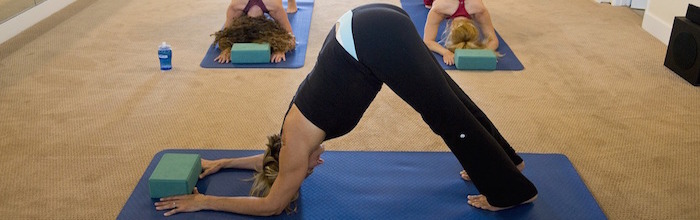
“Downward-facing dog is the most ubiquitous pose in yoga,” writes Sara Calabro on the Huffington Post. That’s very true, but is this actually a good thing?
This popular pose is the yoga world’s ambassador to a largely inflexible public. You see it in advertisements (some naked) for yoga socks, yoga mats, yoga towels, yoga blocks, and yoga nutrition products.
It also appears in movies that involve yoga, usually whenever a sedentary man is trying to impress a super-bendy young woman in a yoga class.
Downward-facing dog, known in Sanskrit as Adho Mukha Svanasana, is not a pose you just throw yourself into, though. And even advanced yoga students, who can contort their bodies into endless pretzel shapes, can benefit from rethinking their relationship with downward-facing dog.
Unfortunately, this pose often shows up in beginner yoga classes, even though it is NOT suitable for beginners.
The “Best” and “Worst” Pose of the Yoga World
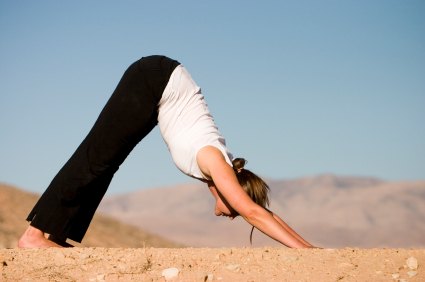 Is downward-facing dog really the worst yoga pose? Should everyone avoid it? Am I going to start my own style of yoga that forbids teachers from using down dogs in their classes?
Not at all.
Even though downward-facing dog will never be the “worst” pose (or even the “best” one), it can still be bad for you. Of course, that can be said for most yoga poses if they are done incorrectly.
But downward-facing dog has two things going for it that makes it more likely to cause problems for students, especially for those who are new to the practice.
- Teachers often fall back on downward-facing dog out of habit, rather than using it with a specific purpose in mind.
- The pose is deceptively easy, with most people able to get into some shape that resembles what you see in Yoga Journal and on YogaGlo.
The Habit of Downward-Facing Dog
 Yoga is all about breaking habits (aka samskaras) and replacing them with other (we hope) better habits. However, in the rush to dive into yoga head first, we sometimes fall into bad patterns without realizing it.
So how did downward-facing dog become a habit? To find that out, you have to look at the tradition of yoga as it passed into the West.
If you’ve ever practiced Ashtanga yoga, you know that downward-facing dog is integral to this style of yoga. As part of the Sun Salutations, it helps turn up the heat in the body at the beginning of a yoga practice.
Ashtanga has had a large influence on yoga in the Western world. Widely known as a vigorous practice, it has been absorbed and adapted by many yoga teachers. The different versions of power yoga—from Baron Baptiste to CorePower Yoga to Bryan Kest—all draw heavily on Ashtanga.
While these Westernized versions of yoga have changed (some would say “watered down” or “destroyed”) some aspects of Ashtanga yoga, downward-facing dog and the Sun Salutations have survived the transition.
Many yoga teachers learn to teach yoga in an Ashtanga-influenced style. As they learn to practice yoga, downward-facing dog becomes part of their yoga habit. When they teach students—and eventually other teachers—downward-facing dog becomes even more fixed in the yoga world.
If you ask a yoga teacher to teach a class without downward-facing dog, they immediately think of a restorative or gentle yoga class. “You have to do downward-facing dog and Sun Salutations to get the body warmed up,” they say.
That’s like thinking you have to drink coffee to stay awake. If coffee is your habit, then it feels like you can’t survive without it. For yoga teachers, downward-facing dog has become a heat-building habit, thrown in at the beginning or in the middle of a yoga practice.
Downward-Facing Dog and the Ego
What would Western yoga be without ego? When we take a yoga class, our ego whispers to us that we can do every yoga pose in spite of our:
- age
- injuries or restrictions
- fitness level
- years of practice.
When beginner yoga students attend their first class—named Yoga 101 or something similar—downward-facing dog is one of the first poses they learn. Not wanting to show any sign of weakness, the students keep attacking the pose, no matter how often it bites back.
“Don’t worry,” says the teacher, “it will get easier.” As if lifting a car over your head is just a matter of trying to lift a car over your head (at a cost of $18 for an hour of sweaty practice, followed by $4 for a refreshing coconut water).
Even though students sign a waiver before class stating that they know their own limits, they don’t really mean it. Many students think their physical limit is either: 1) not being able to move the next day, or 2) feeling something “snap.”
No matter how many times yoga teachers tell their students to “listen to their own bodies,” the students will still gladly suffer through downward-facing dog—as long as teachers keep encouraging them to “force” themselves into the pose.
Beginners, Skip the Down Dogs
But downward-facing dog is NOT a beginner’s pose. This is a pose that only students with a regular yoga practice should attempt. Even if you have the strength to hold yourself up with your arms (like many athletes who come to yoga for the first time), you may need to spend some time opening up your shoulders first.
If done improperly, downward-facing dog can hurt your back, neck, shoulders, arms, wrists, legs, etc. There are so many things that can go wrong with the pose, especially for beginner (and even moderate) yoga students.
For example, if your shoulders are tight, the tension in your arms will move into your shoulders and neck, leaving you with a stiff neck after your yoga practice. If your back is weak, you will struggle to maintain the pose, and your breath will become short and choppy. You might even pull a muscle in your back, leaving you wriggling in pain on your mat after everyone else has left the studio.
Sure, there are other poses that are potentially more dangerous than downward-facing dog, like headstand and shoulder stand. These look challenging, though, so beginners are more likely to avoid them until they are ready.
Because downward-facing dog looks so simple, it lulls you into thinking that anyone can do it. But faking it—by making some sort of inverted V (or U) shape with your body—and doing it correctly are two different things.
Enjoying Downward-Facing Dog’s Many Benefits
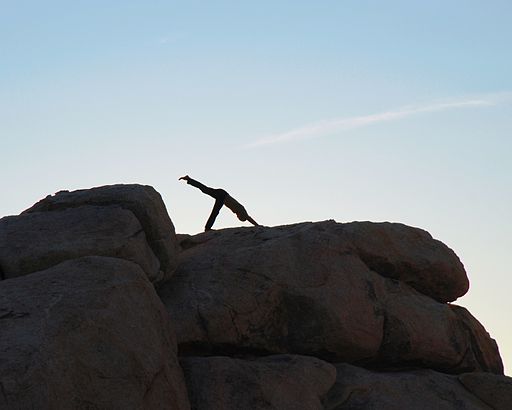 If you want to be able to do downward-facing dog comfortably—without hurting yourself or cursing at your yoga teacher—you need to first strengthen and open up several areas of the body, including your:
- back
- neck
- shoulders
- arms
- wrists
- legs
- etc.
Yes, it’s the same list as before.
To gain all the benefits of downward-facing dog that Calabro talks about in her article on the Huffington Post, you need to work into the pose slowly.
You will make the fastest progress toward downward-facing dog if you work with a qualified yoga teacher. Ideally, you should choose one who understands that you can have an effective yoga practice without having to do downward-facing dog in every class.
You should also keep in mind that yoga sequences consist of three basic parts—preparation, execution, and release. This is true for both the day of your practice, and over the course of weeks or months. If you don’t spend enough time preparing for a yoga pose, you will never enjoy its full benefits. Instead, you will find yourself straining or forcing while in the pose.
To make the most of downward-facing dog, you also need to learn what your limits are (just like it says in the waiver that you signed). Don’t wait for something to “snap” before backing off. Your best guides are:
- Your breath: If you can’t breathe comfortably (slowly and evenly) in a pose, you are not ready for it.
- Your body: If you feel pain, come out of the pose. Don’t suffer in silence. You should tell your teacher exactly where and when you felt the pain. Yoga teachers help those who help themselves.
- Your yoga teacher’s feedback: Listen to your teacher (unless it conflicts with one of the other two guides). And feel free to ask for a second opinion.
If downward-facing dog is not currently part of your yoga practice, don’t rush. It will still be there when you are ready. If you’re already practicing this pose, reassess whether you really enjoy it. If not, maybe you need more time preparing. Or you can try adding some downward dog alternatives to your yoga practice.
Downward-facing dog is a wonderful pose. Yes, it can be bad for you, but it doesn’t have to be. Done correctly, downward dog will bring many benefits to your yoga practice and to your life.
Resources
- 6 Alternatives to Downward-Facing Dog: If you find downward dog challenging, you can still use these poses to add some “dog flavor” to your yoga practice.
- Breath-Centered Yoga with Leslie Kaminoff (DVD): This video includes four complete yoga practices, including a vigorous warrior sequence that avoids stress on the hands and arms (yes, no downward-facing dog).
__________
Photos:
- Downward-facing dog outside: (c) iStockphoto
- One-legged downward-facing dog in Joshua Tree, Wikimedia, (c) Jarek Tuszynski
- Good habits, bad habits sign, Flickr, (c) The People Speak
- Dog doing downward-facing dog, Flickr, (c) Bill





THANK YOU!!! Someone talking sense! I’ve spent the last year teaching without downward dog and am glad about it. Need to understand the body very well and help students into it. But yeah, takes time, strength… don’t want to worsen conditions really!
Denise,
Thanks for the comment. It’s good to know that there are others out there who teach without always falling back on downward-facing dog. I took several months off of that pose in my own practice. Now that my shoulders are more open, it’s a whole new pose … I can actually breathe in it.
Thank you! I am an beginning overweight yoga student…class after class, video after video I quit because of DFD. I just can’t get there I can’t get close, and getting in and out of it floors me – literally. I love yoga and the way it makes me feel. But it has seemed until today that every human on earth can do this except me. Im happy.
Tracia,
I’m so glad you found this post useful. So much yoga exists outside of downward-facing dog (spread the word). The trick will be finding classes that don’t overemphasize this pose.
I always suggest gentle classes for beginning yoga students (even for athletes) because it gives the body more room to adapt to yoga. I taught Back Care and Hatha yoga classes that skipped that pose entirely. Steer clear of vinyasa flow classes, which seem to always use downward-facing dog. Every teacher, though, calls his or her style something different, so sometimes the only way to know is to try out a class.
And don’t feel like you are not “getting” yoga because you aren’t doing downward-facing dog. Many students who do manage to get into the pose have a hard time relaxing in it because they aren’t quite ready for it.
Good luck.
I too have been thinking a bit about this pose. I don’t practice physical yoga, but I know most people who do, they do “down dogs”. In my reasoning the problem starts with a flexed lower back, and lack of movement in the hip joints. Lack of being able to do refined, opposing movements with hips and lower back. That’s like 99% of western people.
Before going into a “down dog”, I propose to check if a simple plank on elbows for 50 seconds is ok. Then, in push up position, let’s see if his abdominal brace is strong enough so he can lift a hand from the floor without twisting or flexing his trunk. Then let’s check 3 push ups with raised legs (feets on a higher surface than the hands).Then lets see if the student can lift a knee towards his belly in standing, without flexing his lower back. If these tests are ok, I’m positive he/she’s all set for downward facing dogs.
Thanks for your comment. I’m always hesitant to say that one or two issues affects the majority of people. As a yoga teacher, I try to look at each student as an individual.
That said, I agree that over-flexion of the lower back and lack of the movement in the hips can negatively affect downward-facing dog. Bending the knees often returns the lower back to its neutral curve in downward-facing dog. This is especially true for people with tight hamstrings.
Checking the core, shoulder, and arm strength (as you propose) are definitely useful before attempting downward-facing dog. Many of these checks can also function as preparatory poses, ones that are used to build strength and increase flexibility in the areas that are needed for downward-facing dog. Of course, this preparation may be over months, not just that day.
In addition to strength in the arms and shoulders, opening the shoulders is essential for downward-facing dog. If your shoulders are tight going into the pose, then you may tense them even more when you put weight on your hands. This may include compensating for weakness or tightness in the shoulders by engaging the large muscles of the back (e.g. trapezius) to hold yourself in the pose, which may come with shrugging your shoulders toward your ears.
I work a lot with my students on opening the shoulders. I’ve also done this personally: I did a year of yoga without any poses that required me to put weight on my hands (down dog, handstand, arm balances). After that, I worked into these poses slowly, trying to maintain some relaxation in my shoulders at the same time. I also found that I could breathe more easily in these poses when I wasn’t tight in the neck and shoulders.
Thanks again for your comments.
I’m just getting in to yoga, and there are a few poses in which I find it hard to breath, so I don’t like doing them, particularly since I am a very deep breather. I can’t afford classes though, so am doing my own practice at home via youtube video’s, but almost all of them that I have found incorporate downward facing dog. Can you suggest something that would be appropriate to do in place of dfd? (although thin, I am very inflexible, with weak knees and weak back) Or do you know of any online (free) video’s that teach an entire session without dfd? Thanks 🙂
Kel,
Finding yoga classes in person or online that don’t include downward-facing dog can be very challenging. One great video is Breath-Centered Yoga with Leslie Kaminoff. I’ve taken some of his workshops and he’s very good.
Other good options are gentle or back-care yoga classes. Beware, even some of these include down dogs. Yes, some teachers start gentle classes with down dog. You may have to do some searching before finding a few that work for you.
As for finding free yoga classes or videos, here are some tips:
Good luck.
Maris Aylward has a Yoga Channel on YT where you can find Hands-Free Wrist-Free Yoga Classes (no Down Dog! No Plank! No Chaturanga)
for example:
That’s great. Thanks for sharing.
Thank you for this video. I just returned from Women’s Wellness weekend which included Yoga. For a number of years, I’ve been trying to get into Yoga, but never do because of my limitations in flexibility. I have a bad arthritic right wrist & hip problems, so I can’t do the poses like DWD or where you put weight on your hand with bent wrist, or where you sit cross legged Indian style. I’m going to try this video and see what I can do. Thanks for sharing
Good luck. I hope the video works out for you. Just remember, yoga should be adapted to fit your body, not the other way around.
DFD is a GOOD thing, if done properly. If you have a teacher that knows anything about biomechanics then they will show you the right way – even if it means modifying the pose to suit the student’s level.
Telling people they shouldn’t do it because they can’t get it right away is ridiculous… Instead, since you are clearly an expert, maybe you should be giving them the tools and knowledge you no doubt have to help them get to that level?
Yes, it’s quite obvious that I am a big fan of DFD, but, like you, the safety of others comes first – but I don’t just shun a position that is OBVIOUSLY very good for you (with all the benefits one reaps from doing it – PROPERLY).
I teach yoga to a class of plus size women and not one could do it it when we started, they can ALL do it now… Yes, with proper form.
I’m not claiming to be a great teacher; at all. But, I do know how to bring a client from point A to point B (in a safe and healthy manner).
Majik,
You have some great points, especially about working with a qualified teacher and working up to downward facing dog. You said that your plus size students couldn’t do downward-facing dog in the beginning. I’d be interested in hearing how you prepared them for doing the pose safely.
I am a big fan of downward-facing dog, as well. I just want to help students get the most benefits out of it. Doing downward-facing dog is like getting married: you should do it only when you are ready. That means preparation and proper form (for the pose and marriage).
Personally, I think working up to a pose doesn’t always mean doing the pose until it gets easier. Many of my students, especially new ones or those with shoulder/neck injuries keep doing downward-facing dog because they think if they suffer through it enough times it will get easier. But if you go into a pose and cannot breathe smoothly or you tense your muscles, you may need more preparation.
Modifications and proper form can help students do a pose safely and effectively, but so can preparation. That means preparation during the class and over the days/weeks leading up to the class. If you do more preparation before tackling a challenging pose, that pose will seem that much easier when you try it again. Why rush it? It’s okay to not do a pose right away.
As for providing the tools that people can use to get to the next level in downward-facing dog, I think a blog post is not the best approach. As you said, teachers need to know how to get people safely from point A to point B. But every student has his or her own point A, point B, and path in between. Students are better off working with a teacher one-on-one to help them do a pose safely, rather than reading a post saying “do this, it works for everyone.”
Thanks for the conversation. It is always helpful to question why we are integrating each posture into our ongoing practices. It never occurred to me that Adho Mukha Svanasana could be the least bit harmful. I see it as a resting pose and a meditation. I am in Love with this posture, for it allows me to investigate so many of the nuances of my practice from a static posture. It may be true that for some, this posture not fit their body at first. This is a key lesson for all practitioners, to listen to our bodies. Let’s not get into judging the asanas themselves as good or bad, for anyone or everyone. Adho Mukha Svanasana can be one of the most healing and restorative asanas as well. Find a good teacher, learn the asanas properly, enjoy!
Well said, especially about asanas being neither good nor bad. Sometimes if you attempt a pose before you are ready, it may feel like a pose is “bad.” Although I’d probably say it was an “inappropriate” pose (for you, at that moment in time and space). And yes, find a good teacher, learn the asanas properly, and you will gain the many benefits of yoga.
I’m 33 years old and I’ve been practicing yoga for almost two months and i get frustrated with this pose because i don’t have a lot of strength in my arms and i don’t hold very long… will i be able to do it as time goes by? Cause i have fybromialgia and i don’t if it’s because of it or if it’s normal because i’m a beginner…
Elisabete,
It’s not uncommon for people to struggle with downward-facing dog, even in people without fibromyalgia. Your arms will get stronger the more you do the pose. But there are other poses that will develop your arm strength. Preparing with simpler poses can often be easier than just pushing through downward-facing dog because there are fewer things to think about.
One of these is table-top pose (hands and knees on floor, back flat) — extend one arm out in front of you parallel to the floor, with the option of extending the opposite leg back parallel to the floor.
Plank pose is another one, more challenging than table-top. You can also try extending the arm/leg and try balancing on one arm/leg in this pose.
In both of these (as in all poses), if you have difficulty breathing smoothly, back off a bit. It may take days/weeks to move to a more challenging version. But don’t worry, it’s still yoga even if you are doing simple movements, as long as you keep bringing your focus back to your body and breathing.
Sometimes, tight shoulders or a weak back can also make your arms seem weaker, because you are trying to use your arm strength to compensate for tightness or weakness elsewhere. Ask one of your yoga teachers to take a look at your downward-facing dog. He or she may have some good pointers for you.
The problem with downward dog is that it puts the body into a right angled shape stressing the natural lumbar curve, hyper extending the knee and flattening the natural tension in the arch when bells are ousted to the floor. I have created a new way to do downward dog that creates strength to the back as when knew are straight, back muscles are inhibited from recruitment and many people are just hanging from the posterior ligaments in order to fit the curving shape of the body into a right angle. I created YogAlign where each pose requires posture to simulate upright alignment. The YogAlign down dog is called Core Dog and one knee is kept bent while the other leg is lifts and extended to line up with the hips and spine. The chest is never pushed to the floor and arms are kept below the level of the ears. Doing a downward dog where one keeps the knees straight, heels down and chest lowered to floor is hugely damaging to the ligament stabilizing forces in the wrist, shoulder, neck, spine, sacrum, hip, knee and foot joint. This pose overrides natural anatomical joint function. See http://www.yogainjuries.com for more information.
Michaelle,
Thanks for the comment. I have played with bending one knee and extending the other leg in downward-facing dog before. I think it can help get the sensation of extending the spine, which is one thing that I focus on in the pose. Your are right, forcing your heels or chest to the floor in the pose can be harmful (and few of us are built to achieve full heel touchdown). Plus, you start to think that’s the goal of the pose, and lose sight of what’s going on in your back. Bending the knees is useful in downward-facing dog, just as it is in standing forward bend (uttanasa), especially when your hamstrings are really tight.
Keep talking about the dangers of downward dog.. There are some teachers who start classes with a 5 minute downward dog ! This is a perfect storm for damage to the joint structures of the spine, hip, knees, shoulders and feet.
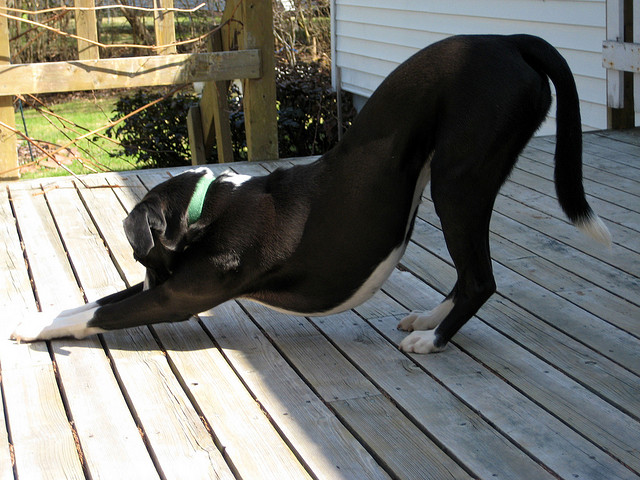
Also did you ever notice that dogs do not have extended or straight knees when they do down dog? It makes no sense to bend forward with the knees straight in down dog but also any forward bends. Humans are designed to move and that requires bending at least one knee and when we do yoga poses where the knees are locked out, it is like driving a car with the brake on.
I always ask people in my YogAlign trainings to try and walk across the room without bending either knee. It becomes very obvious that the body does not ‘Lie” .. It basically makes no anatomical sense to do these straight knee poses. So basically there is no point in bending forward or in doing down dog with both knees straight..
I’ve also seen yoga classes that start with five minutes of handstand. That’s not my thing at all. I’m a big believer in proper preparation for yoga poses.
I know from my own experience that it’s difficult to start with downward-facing dog and keep my breath smooth and even. Some teachers would say “stick through it” until you are warmed up, but I think there are many better (and faster) ways to prepare for downward dog than just doing more downward dog.
And yes, straight legs is not the way to go. Even if you are one of the very few with extremely open hamstrings and lower back muscles, you should avoid locking your legs. The legs muscles should be active, instead of just using your body weight to push the leg into a locked position.
The title looked intriguing. I read the whole article but couldn’t find the answer… “…can hurt your back, neck, shoulders, arms, wrists, legs…” – OK. But why? All of that can happen in ANY posture or even in any situation in your life.
As somebody who suffers from a slipped disc and a variety of related issues, I can tell that downward dog is one of the safest way to get into a forward bend when done correctly because it’s a supported forward bend (through the hands, feet and floor) which helps maintaining the right alignment in the lower back. I’ve hurt myself badly a few times when doing standing forward bend and sitting forward bend (because it’s more difficult to prevent the lower back from rounding) but never in downward dog. There are a number of modifications and intermmediate poses that a wise teacher would teach. It’s really about how you do downward dog and not about whether you do it or not at all.
Vajra,
You are right, the “badness” of downward-facing dog is really about how you do the pose. And many other poses can create problems, as well. But downward-facing dog is often a fall-back pose in yoga classes, even if people are not ready to be in it. It would be difficult to maintain the right alignment in downward-facing dog if your shoulders aren’t open and your arms and back aren’t strong enough. I’m glad you have found a way to enjoy the benefits of the pose, especially with your slipped disc.
Thank you for this article. I started doing yoga in 1980…33 years ago. We didn’t do downward dog every single class. Nor did we do sun salutations every single class. We did a variety of poses every class. I think our teacher back then gave us dozens and dozens if not hundreds of different poses and I really appreciated that! Classes were an hour long and each pose was held 3-5 minutes. Beginners stopped sooner, advanced held it the longest. Always ended with corpse pose for like 10 minutes which I had some amazing revelations and deep relaxation.
I cannot find a class like this any more. No matter where I try, online or in person, every class seems to hold poses for a short time with dozens of downward dogs and usually sun salutations. Not only am I supers bored with these poses, I CRAVE other poses. And, I crave the stillness and the holding the pose. I do not need downward dog as much as I need things like Pigeon or twists or cobras. I find it very annoying this trend and I wish I could find more alternatives. Thanks again.
Alicia,
Thanks for your comment. Yoga has definitely changed in the U.S. since the 1980s. I think there are still some teachers who hold the poses longer, but they are lost amid the power yoga moving-all-the-time classes. I’ve taken classes like you described. Most were called Hatha (as opposed to vinyasa or flow). You really get a different experience when you are in a pose for five minutes. It’s especially challenging to keep the mind still when we are used to lots of movement in yoga.
You may not see this as your post is a year old, but there are classes that hold poses for 3-5 minutes, they call this Yin Yoga and it is becoming popular now. See if you can find them. One website for more information is mindfulyinyoga.com Good luck.
Tracy,
Thanks for your comment. I’ve done some yin yoga, too. It can be a nice change for people not up for fast-paced vinyasa flows. Of course, people shouldn’t confuse it with restorative yoga, which is very restful. Yin yoga can actually be pretty intense.
Also, some yin teachers use downward-facing dog in their classes, either as a transition pose or holding it longer. So people who don’t feel ready for downward-facing dog should consider an alternative pose rather than ‘plowing through.’
Try YogAlign.. Its the yoga that aligns your posture while you self massage and tone your core using breathing.. No dangerous poses at all
Thank you!!
I have tried alternative downward facing dog poses against the wall because of double rotator cuff impingement but it really interrupts the flow if I have to go stand next to a wall. In one 30 minute class we did 15 downward facing dogs! (Yes, I counted. Shame.) It was like being on a roller coaster!
I really do enjoy the pose but not that much and not for very long and the plank that follows is also very difficult. I can’t focus on breath when focusing on pain. Ironically, I started yoga 3 weeks ago to help with the pain.
I did find some videos that are helpful. Ekhart Yoga on YouTube has two yoga flow videos avoiding downward dog. They’re pretty fast paced though.
I do hope to be able to enjoy downward dog someday.
But thanks for the article. It gave me hope!
That’s why it’s so challenging to take group yoga classes. You can’t always adjust the poses to fit your body/needs. Tabletop pose is a good option instead of downward-facing dog when you’re trying to keep up with a flow. You can focus on stabilizing your shoulders in that position, and then work on lifting one arm in front of you to build some arm/core strength.
I would also suggest doing some gentle shoulder openers before and after class. When my neck/shoulders were bothering me a lot, I would inhale my arms out to the side and up overhead (palms face toward each other at the top), and exhale them back down. Repeat several times, bending the elbows if your shoulders are tight. Then do same thing, except out to the front and up (palms facing forward at the top). Gentle movements repeated often work wonders.
I’ve seen the Ekhart Yoga videos. There are some good ones on there. If you memorize the flow, you can move at your own pace without the video. My practice improved a lot when I started memorizing flows.
Good luck with your yoga practice.
Shawn
THANK you for this. A lot (I mean: A LOT!) of instructors seem to imply Downward dog is a beginner’s pose. I found out the hard way it isn’t before reading your article! :-/ I’m going to rub this great article in a lot if instructors’ faces, if it’s ok with you.
I really find any critique that doesn’t address alternatives to be incomplete.
I don’t teach, but I’ve practiced for over a decade and went through a 200 hour basic training in vinyasa. I still consider myself very much a beginner.
Since I have an old wrist injury (break) I found to be aggravated and hurt by too many down dogs in a relatively aggressive power vinyasa form- I learned that Dolphin was a good alternative at least for me. It doesn’t gve me as much space to decompress my spine- but there still enough room and I can comfortably rest my forehead on the mat. My wrists are relieved of the harmful-in-excess pressure, weight distributes evenly along both forearms. I still get most of the benefit of the down dog posture without the harm to my wrist. It is only helpful and strengthening in moderate reasonable amounts. I find the shorter/closer leverage point of my elbows helps me work into and open up my shoulders in a less strenuous way.
I highly recommend Dolphin as an alternative to Down Dog and you can modify the rest of a basic sun salutation vinyasa to go along with it with perhaps some added steps to get gracefully in and out of postures. But it’s totally possible and I learned to modify my vinyasa flow using just dolphin. Shameless use of child’s pose too.
On a side note in all discussions and debates it is always appreciated to present your own ‘better’-in-some-situations suggestion rather than simply highlight a potential challenge. Don’t just curse the darkness light a candle if you will. I was surprised to see no mention of dolphin. It is one of the easiest modifications to go-to from Down Dog.
Leah,
Thanks for your comment. I completely agree that I should have provided some options for people who aren’t comfortable with downward-facing dog. When I originally wrote the post, I thought about including alternative poses to downward-facing dog. But then I realized that that would be a post all by itself (someday I’ll get around to it).
Providing alternatives to downward dog is challenging, because there are so many reasons that people have trouble with the pose. There is no one best alternative for everyone. I think working with a yoga teacher in person is the best option. That way, he or she can help you work on the stuff that’s holding you back.
Aside from that, Leslie Kaminoff’s yoga DVD provides a good alternative to classes with lots of down dogs. It focuses a lot on strengthening the back, but still provides a vigorous warrior workout without stress on the hands or arms. (I just added the link to the DVD to my post.)
I completely agree with you that dolphin is a good choice for people with wrist issues. When I started doing power yoga (which uses many, many downward dogs), my wrists were in bad shape. So I fell back on dolphin a lot. And “shameless use of child’s pose” (I love that phrase).
When I work with students who are hesitant about downward-facing dog, though, I spend a lot of time on first opening the shoulders, strengthening the back, and loosening the wrists. After that, I have them slowly start to develop arm strength with table (increasing to one leg/arm lifted) and plank. My classes tend to be slower-paced than many power yoga or flow yoga classes, so it’s easier to adapt to fit the needs of my students.
Of course, sometimes the best alternative to a challenging pose is more preparation, rather than trying to find an alternative pose. But, as you did with dolphin, sometimes you can find a pose that is comfortable and provides the same (or similar) benefit.
Great article! I stopped yoga because I was always hurt. Strained muscles or other pain. I’m afraid to start again because I don’t know how. I have to do it on my own because the only studio around here (I live in the countryside, tiny village) have me the painful lessons 🙁
Thanks so much for the article but I don’t do yoga. I injured myself teaching a yoga class. As I learned more about Yoga I saw that its moves are dangerous. I’m also not a fan of its spiritual roots. I teach Active Isolated Stretch invented by a Physical Therapist. It has sound principles of stretching and a systematic approach. Yoga is a very old practice and some of the moves contraindicative. I believe we’ve become smarter about the body and movement patterns through the years. Thanks again your article is right on target.
Sara, thanks for your comment.
I agree that some yoga moves are contraindicated for certain people, but many more are beneficial. Some of the problems in yoga come not from the poses, but the way they are taught. In group classes there is a tendency to try to fit everyone into the same poses and sequences. Yoga really should be customized to fit each person based on their needs and restrictions.
Imagine doing group Physical Therapy classes–you’d lose a lot of the benefits. Or going to a physical therapist who has only had 200 hours of training (as do many yoga teachers). Or having a physical therapist who doesn’t tell you to back off when you are doing something potentially dangerous (or you not listening to your physical therapist).
I think yoga can learn much from other physical movement systems. But even then, the physical aspects of yoga are only one small piece of it. In the Western world, there’s been an overemphasis on this as the end goal. So what gets lost is learning how to focus the mind and be still. True, yoga has spiritual roots, but different traditions emphasize them to different degrees. Some traditions are more practical, with the emphasis being on clearing your mind and finding some stillness. Once you have that, you can choose to apply it to more spiritual study or just life in general.
So, I think if you’d had a bad experience with yoga, there may still be another style out there that has something to offer. In the end, though, it’s important to find something that works for you. I always tell my yoga students, “If yoga doesn’t help you deal with the stress in your life, then maybe you need a different kind of yoga practice.”
I used to hate downward dog but I guess I got used to it. Now I really hate table pose – the one where you’re upside down not just on your hands and knees. My teacher just says, “Get your bum up!” but it feels totally wrong like my shoulders are not meant to bend that way. She’s obviously a lousy teacher but what do you think I’m doing wrong? I developed frozen shoulder when I first started yoga and although it’s better now I suspect I am still protecting or maybe just not trusting my shoulders.
If you experience pain during a yoga class, the best thing to do is to come out of the pose. Sometimes your teacher can give you other options in the middle of the class. But often it’s better to talk to your teacher after class when there is more time for him/her to work with you in that pose.
Without seeing you in person, it’s hard to know what’s going on with your shoulder in reverse tabletop pose. But I suspect your “frozen shoulder” is still giving you problems.
Shoulders are very sensitive and delicate, so I like to err on the side of caution. You might want to check with a doctor or chiropractor. You could have a rotator cuff injury. This type of injury can be made worse by many yoga poses, especially ones where the hands are on the floor. If you have shoulder pain at any other time, even outside of class, definitely have it checked out.
When you try reverse tabletop again, keep in mind these tips: Avoid hanging your torso between your shoulders like a hammock. You can stabilize your shoulders by drawing your shoulder blades together slightly and down your back. Also, your chest should be opening up; think broad chest. Try pressing your thumbs more firmly into the mat and rolling the biceps slightly away from your torso; this may help you stabilize your shoulder.
Again, it’s easier for a teacher to walk you through this in person. This also works best if you aren’t rushing to the next pose. You can also use your own body as a guide. If you start to feel pain, come out of the pose. If you can’t breathe smoothly, come out of the pose.
If you still feel pain in reverse tabletop, spend some time opening up your shoulder before trying this pose again. As I said with downward-facing dog, sometimes the best preparation for a pose is actually not doing the pose. When I had shoulder problems, I avoided any pose with my hands on the floor … for several months. This allowed me to focus on opening and stabilizing my shoulders.
Here are two of my favorite gentle shoulder/neck openers. You can do this any time. I often do them just before bed to help me sleep.
It actually doesn’t hurt, my shoulders just won’t bend that way but I must be starting from the wrong position, I think I’m curling my shoulders in in self protection. I will try drawing my shoulder blades in and down before I start. And “think broad chest” is a great visual that may help overcome my mental block. It’s like my whole being is saying NO! WE MUST NOT DO THAT! I like to listen to my body but maybe this time it is over reacting.
When the frozen shoulder was the worst, if I made a sudden movement with my arm, to catch my balance or something, I would get a shooting pain from the shoulder through my arm down to my fingers kind of like the worst funny bone pain ever. It worked like aversion therapy so I was scared to use that arm and it got weaker and more useless. It’s taken a really long time to unlearn the protective response. Yoga (with the right instructor) and pilates have helped me build back up the strength and range of motion. I guess my aversion to reverse tabletop is just left over from that time.
Thank you so much for your help!
I hope that helps. Even if there is no pain, it’s useful to do some gentle shoulder openers before more intense poses.
In my own yoga practice, I always like to come close to the tightness and then back away, rather than push through. Over time, some of that tightness goes away. If you push too hard, your body may react and try to protect itself.
Good luck.
Thanks a lot Shawn. This article makes absolute sense. My poor husband has suffered a severe problem after doing the downward dog in a beginners class. This was last November and he is still trying to find a solution to the constant upper arm pain and swelling he has to endure. I am so angry that his yoga teacher doesn’t seem to think it’s anything to do with him. At least this will reassure
him that this is the definite cause.Any suggestions about seeking help to sort this out ?
Anne,
My advice to yoga students is always this: If you hurt after doing a yoga pose, maybe that’s not your pose right now. Your husband might need to take a break from downward-facing dog, if that’s the pose that’s bothering him. Or he can ask his yoga teacher to watch him in the pose to see if he needs to adjust the way he does it.
When I work with beginners on downward-facing dog, I like to start by opening the shoulders and the back. Not just that day, but over months. If your shoulders are tight, downward dog is not very pleasant. After that, I help them slowly build arm, shoulder and back strength. This often means not doing downward dog for a while. There are lots of alternatives you can do in a yoga class, though.
If your husband has constant arm pain and swelling in his arm right now, that might be a sign of a bigger problem with his arm or shoulder. He should talk to his doctor to rule any injuries or other medical problems.
Good luck.
Shawn
Can A Strong Core Reduce… Even Eliminate Your Joint Pain?
You may have heard that a strong core is important for physical fitness.
Unfortunately, what you’ve heard probably starts and stops with your abs, so you get a “sexy,” ripped” six-pack. That practically guarantees joint pain.
Why?
If your core is weak, your joints compensate by bearing weight that your muscles can’t. Then target one muscle in particular and all the other weak muscles compensate, stressing your joints even more.
Sooner, rather than later, that stress leads to joint pain in a vicious, downward spiral.
What you probably haven’t heard is how a strong core can protect your joints, even end joint pain at the source.
Because your core is a system of 29 pairs of muscles.
But until now, this knowledge has been the exclusive professional secret of the very best sports doctors and physical therapists working for professional sports teams.
Most of us just don’t have access to doctors and physical therapists who know how to teach you to engage, activate and above all, balance your core muscles.
Quickly, without expensive equipment, complicated protocols, or spending several hours a day in physical therapy.
Until now, thanks to former NBA pro and chronic joint pain relief expert Jonathan Bender. Who has a gift for making the complicated. Simple and easy.
If you don’t want to suffer from joint pain any longer… or you want to escape it altogether, click to read “5 Ways Your Core Protects Your Joints.”
It’s already improving my life. I think it can do the same for you.
Hi,
in one of your replies you talked about opening the shoulders and back while sitting out on the downward dog. What poses exactly did you use to do so? Did you do only yoga poses or some sort of fascial release techniques as well. I want to feel that pose in a whole new way as well 🙂
Thanks a ton,
Sascha
Sascha,
To open the shoulders and back muscles, I use a combination of static and dynamic (moving) yoga poses, as well as some fascial release.
My favorite method of opening up tight areas of the body is to use gentle, dynamic poses. This is common in the viniyoga style of yoga (e.g. TKV Desikachar and Gary Kraftsow). Check out Kraftsow’s book Yoga for Wellness. It has sections for shoulders/neck and upper/lower back. I think he also has some good videos.
You may be able to find the book or videos at your public library (I’m a big fan of libraries!), or ask your library to request it from another library or buy it for its own collection.
For fascial release, I’d suggest finding a good teacher. I think this is harder to learn from a book or video. You could also try yin yoga.
Whatever style you choose, be careful not to push too hard. We sometimes have a tendency to try to “push through” the areas of tight. You can injure yourself if you apply too much force.
It took years to build up the tension in your body, so it will take time to work through it. I like to imagine this as sanding down the tight areas with gentle movements and breathing.
Good luck.
Shawn
Nice click-bait headline Shawn, I should have known this article would be garbage
Took a class in NYC years back with Glen Black. He informed me that I should not be doing downdog due to lack of shoulder mobility.
I enjoy Ashtanga classes and rest in plank or child pose during the downward dogs. It really does not go over to well with many instructors but I figured Glen has more experience than most instructors.
Pete,
That’s great that you’ve found a teacher who understands that not every pose works for everyone. I saw an interview with Glenn on the Huffington Post, shortly after William Broad wrote in the New York Times about yoga injuries. He has some great points about doing yoga safely.
Shawn
Downward dog makes me want to quit yoga. It’s the part I dislike the most.
You are not alone in feeling that way. It’s okay to skip that pose, even in group classes. Child’s pose or extended puppy pose are good alternatives for downward facing dog in a flow class. I mention a few other alternatives to downward-facing dog on this post.